




Algebra typed on tape for MIT’s Whirlwind in 1953, rebuilt from its manual by a coding agent. Its programs run. Its rules turn up a slip in its own arithmetic, a 1954 copy that would not have run, and a computed zero index in Knuth and Trabb Pardo’s 1976 example that it forbids.
Published manuscript · v1.2
01 / A COMPUTER WITHIN A COMPUTER
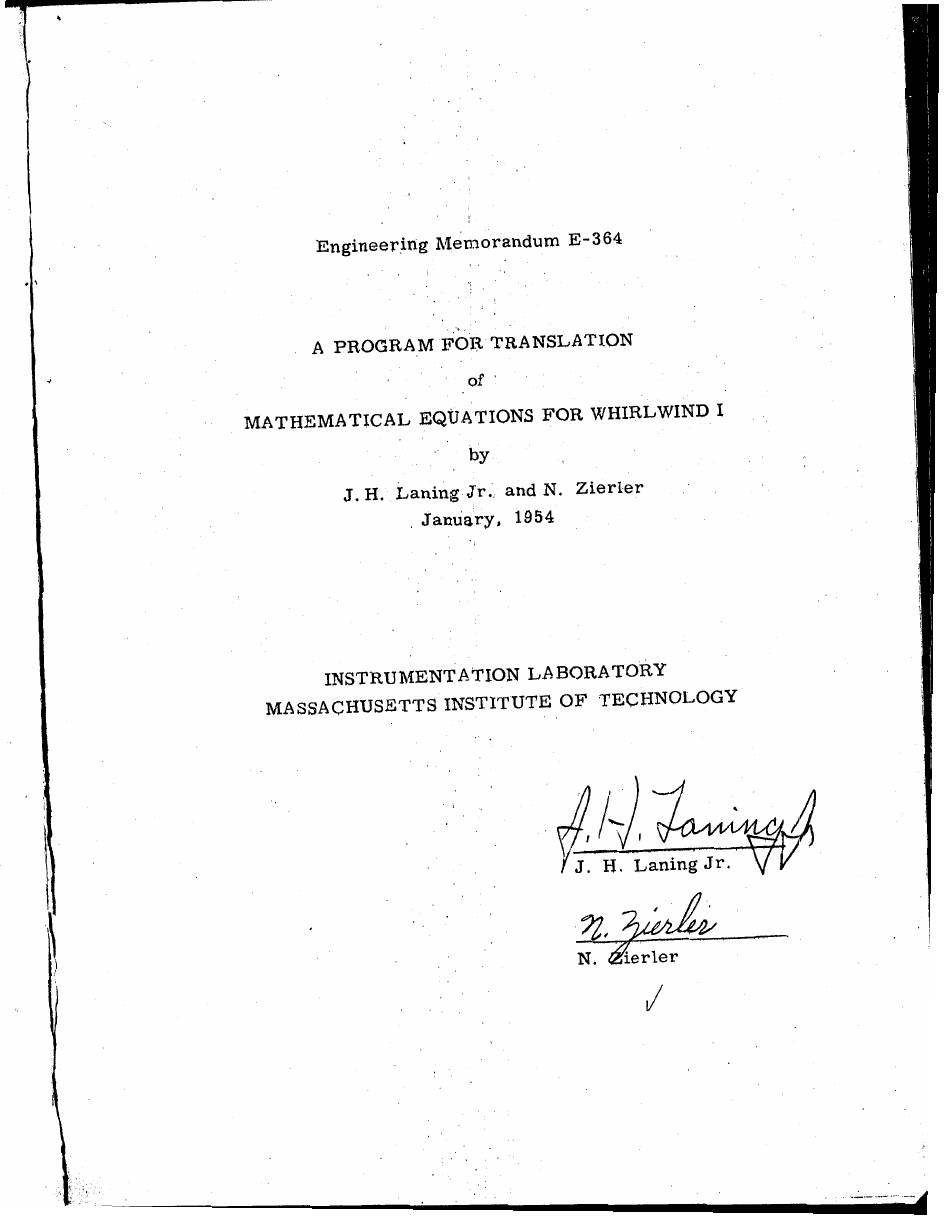
In 1952 J. H. Laning Jr. of the MIT Instrumentation Laboratory wrote a program that let Whirlwind I take mathematics typed as mathematics, and with N. Zierler made it a usable system by May 1953. Equations typed on a Flexowriter were punched on paper tape, translated into Whirlwind’s own instructions, and the answers typed back. “The effect of our program is to create a computer within a computer …” In 1954 John Backus came to MIT with two colleagues to see it run. I asked a coding agent to rebuild the system from its manual, Engineering Memorandum E-364, and to run the manual’s programs under the manual’s own rules.
02 / EXHAUSTIVE TESTS HAVE NOT BEEN MADE
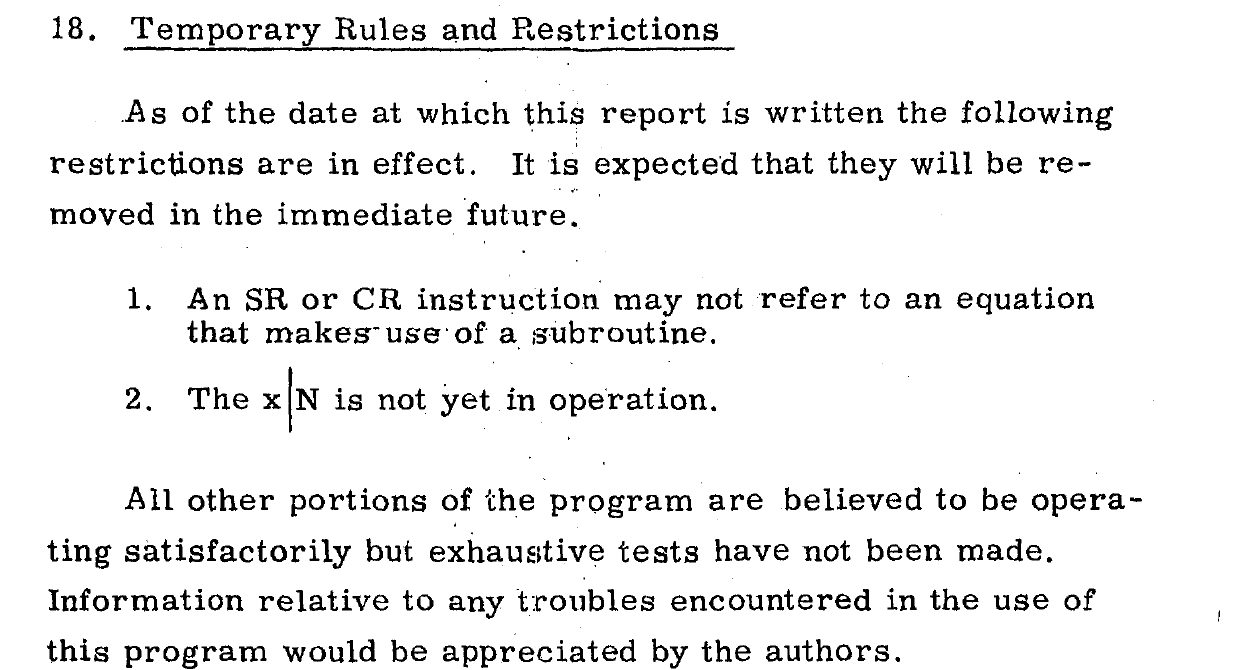
The manual ends with Temporary Rules and Restrictions, among them “The x|N is not yet in operation.” Then: “All other portions of the program are believed to be operating satisfactorily but exhaustive tests have not been made. Information relative to any troubles encountered in the use of this program would be appreciated by the authors.” A progress report for the first quarter of 1954 says every routine had been tested and worked except the x|N routine. I have not found Zierler’s report on the program’s inner workings, and that summer it was said that “there are no annotated copies of the conversion routine”. So the manual is the specification, and what it does not say is this reconstruction’s choice.
Project Whirlwind Summary Report No. 37, first quarter 1954 ↗
03 / A PERFECTLY REASONABLE EXPRESSION
Multiplication is writing things side by side: 2ay is 2 times a times y, and a space between two digits is a multiplication sign, so 2 3 is six. Inside a term a slash sends everything after it to the other side of the fraction, until the next slash. So cd/a(b + c) is cd over a(b + c), and “a/b/c is properly interpreted as the product ac divided by b”, not a over bc, as FORTRAN would have it. In 1976 Laning wrote: “The notion of operator precedence as a formal concept did not occur to me at the time; I lived in fear that someone would write a perfectly reasonable algebraic expression that my system would not analyze correctly.”
04 / TWO ZEROS
Numbers have 24 binary digits and an exponent, about seven decimal places, and zero has a sign. CP jumps if the last quantity computed was negative, and on a zero “the CP may or may not behave like an SP since 0 may appear as +0 or −0.” The manual’s loops step round this: to go round ten times one tests n − 9.5, never n − 10, and another counts down in twos, so its test never comes to zero. The reconstruction has to decide, and my inference is a one’s-complement adder’s: a zero typed as 0 is +0, and the difference of two equal numbers is −0. So n − 5 with n equal to 5 is typed −.00000000+00, and CP jumps.
05 / KNUTH’S EXAMPLE AND THE 1954 RULES
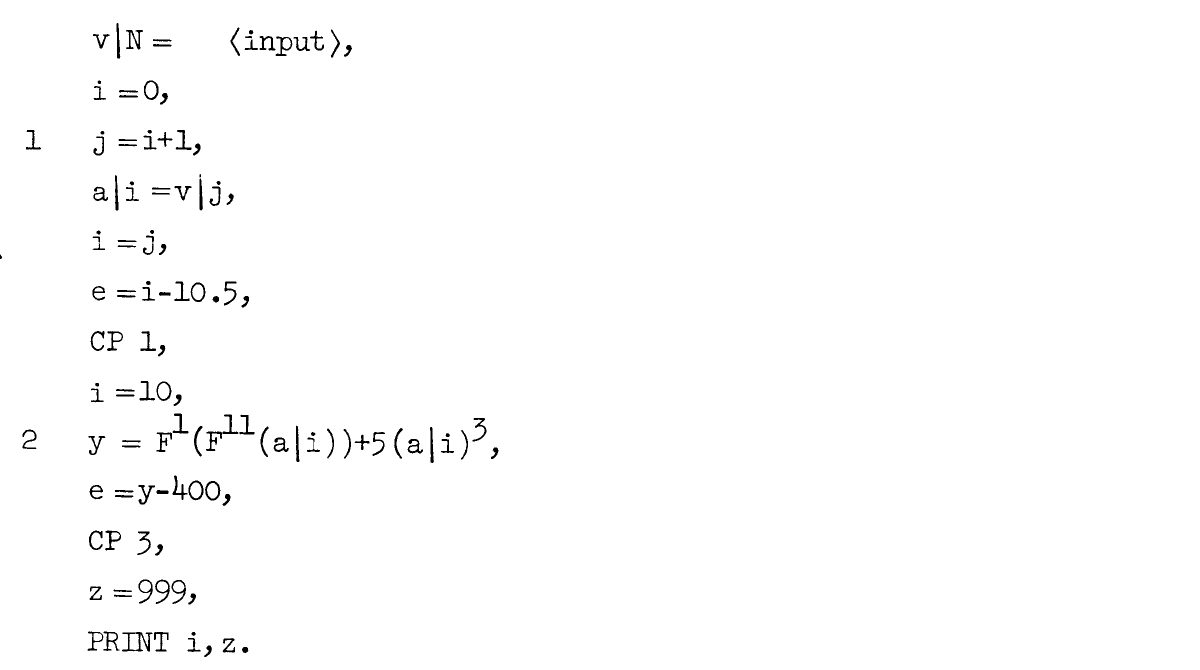
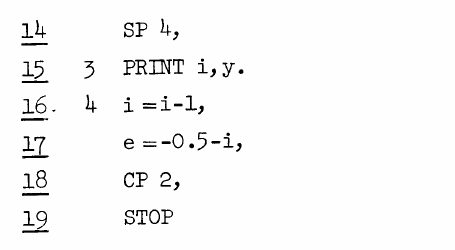
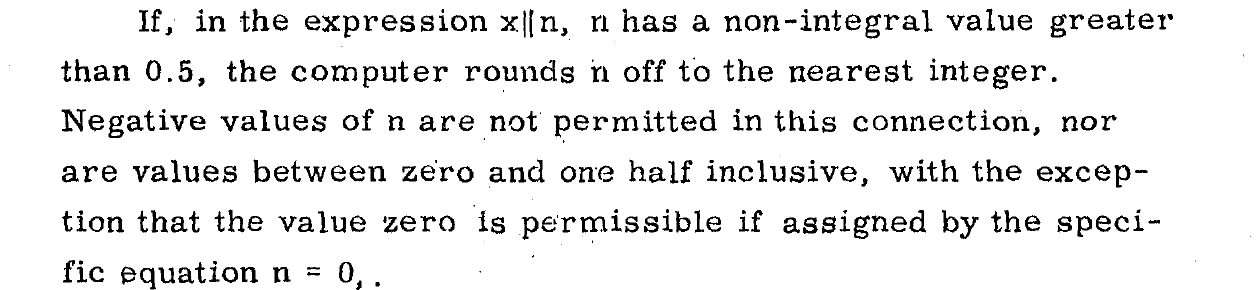
Knuth and Trabb Pardo’s 1976 example in the language, TPK, reads eleven numbers with v|N, copies them to a|0 to a|10, and works back down with i = i − 1. Page 13 allows a letter as an index, but: “Negative values of n are not permitted in this connection, nor are values between zero and one half inclusive, with the exception that the value zero is permissible if assigned by the specific equation n = 0,.” The last time round, i is zero, and it got there by i = i − 1, not by i = 0. Page 13 forbids that whatever the zero’s sign, so the 1976 example and the 1954 specification are incompatible. Under the rules of January 1954 it could not have run at all, because it begins with v|N, and “The x|N is not yet in operation.” What the reconstruction does about it is a separate matter. It approximates page 13 by the sign of zero, refusing −0 and allowing +0, and since my inference is that a computed zero is −0, it types ten lines and then ALARM EQUATION 2 PRECEDED BY 109. That alarm rests on the inference, not on the manual, which names no alarm for it. Make every zero +0 and TPK runs to the end, still breaking the rule. Its checker points at i = i − 1 before anything runs.
06 / THE INNOCUOUS CHANGE
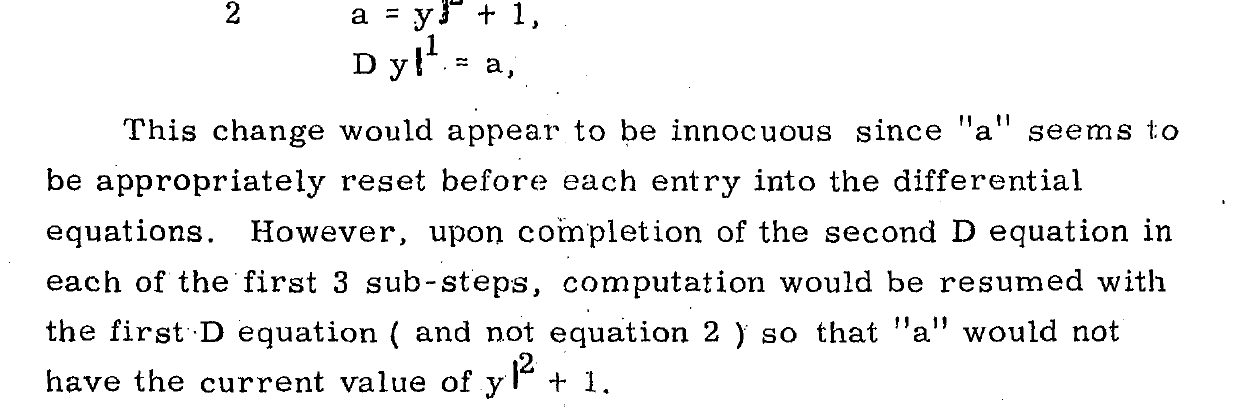
Write dy/dt as D y = …, and the stretch from the first D equation to the last is gone through four times a step, by “the method of Gill - a variation of the 4th order Runge-Kutta technique”. The manual’s example has the answers sin(t − 2) and cos(t − 2) − 1, and the reconstruction is within about .004 of them at every t it prints: what a step of one half costs. Then the manual warns. Move y|2 + 1 into a helper, a = y|2 + 1, just before the first D equation, and the change “would appear to be innocuous”. It is not, because the later passes start at the first D equation and never recompute a. At t = 10, y|1 is 2.58 where sin 8 is .99. The checker warns about it, quoting the page.
07 / A PROGRAM THAT WOULD NOT HAVE RUN
The MIT summer school notes of 1954 give their own, shorter version of the manual’s differential-equation program. As printed, its last two lines lack the commas the rules require, so the translator would not have accepted it. It also has no PRINT, so with the commas put back it integrates from t = 2 to past t = 10 and types nothing; it may have been meant to leave its answers in storage. The manual’s own examples have three smaller slips: a missing comma on page 8, a semicolon for a comma on page 11, and a figure on page 7 that types a ninth value nobody asked for. The manual has a slip of its own, on page 6. Its largest number, 2⁶³ − 2³⁹, is “(or, roughly, 9.2233995 · 10¹⁸)”. It is 9.2233715 · 10¹⁸, wrong in the fifth decimal place. And the manual prints .05 as +.50000000−01, which the nearest 24-bit number to .05 gives only if the digits are cut off rather than rounded. So the reconstruction cuts them off: a choice that fits the page, not something the page proves.
08 / IT RAN THE FIRST TIME
These are the troubles the authors asked for, seventy years late: slips in the manual, one in a copy of it, and the rest its rules doing what they say. The system itself did real work. Laning recalled a three-dimensional lead-pursuit problem, coded with its sceptical owners “in a 2-1/2 hour coding session, at least half of which was spent in defining notation”, which “ran successfully the first time”: 79 statements, with seven uses of the differential-equation feature. The summer school heard that “with a single exception, all programs coded in the Laning-Zierler system have been completed successfully on their first run”. The price was speed: “a reduction of computing speed of the order of magnitude of ten to one from an efficient computer program”, as C. W. Adams put it in May 1954, and six to eight times the Laboratory’s usual interpretive system, as the summer school did.
The system runs in the browser, compiled from the same Rust source as the command-line version, with the manual’s programs among its tapes. Type a tape, feed it, and the printer types the answers, as slowly as ten characters a second if you like. The translation shows each equation’s block of orders, and the same tape can be fed with each kind of zero side by side.
WHAT THIS DOES NOT SHOW
- I have not found the translator itself. This is built from a programmer’s manual, which says what the system does and not how. Matching the manual’s examples says nothing about what it does not describe.
- The manual prints almost none of what its programs typed. Three numbers on page 6, 5, .05 and −π, can be compared digit for digit, and match; everything else is checked against mathematics, not against Whirlwind.
- The sign of a computed zero is an inference from the manual’s warning on page 8 and from the arithmetic of the time, not from a listing. The reconstruction uses that sign to approximate the rule of page 13, so it lets through some computed zeros the rule forbids, such as n = 0·5, and the TPK alarm rests on the inference. The alarm’s wording is this reconstruction’s.
- TPK was never run on Whirlwind, as far as I know. Knuth and Trabb Pardo wrote it to show what the language looked like, not to test it.
- How Gill’s method was arranged inside the system, the rounding of each operation, the function routines, and what happened to a number too small to hold are this reconstruction’s choices, each listed in the repository. Nothing is timed.
- The pages were read by the same coding agent that wrote the interpreter, from the page images. No person has checked the reading against the scans by eye. A second model, OpenAI’s Codex, reviewed the repository independently and checked twenty places against the page images: seventeen matched, and three were repairs that had not been disclosed, the three slips in the manual’s examples, which are now listed. It also found that the option making every zero +0 left a negated zero as −0, which is fixed. Its review, and what was done about each point, is in the repository.
- No search has been made for earlier discussion of these troubles. Someone may well have noticed them before.
When only the manual survives, its rules are the program. Running them shows what the rules say, not what Whirlwind did.
If a manual is all that survives, can you tell what the program did?
The three complete programs in E-364 run on the reconstruction and give answers that check against mathematics. That shows the manual is consistent with itself and with arithmetic. It does not show that Whirlwind typed the same eight digits, or did the same thing when a tape broke a rule. Only a printout from 1953 or 1954, or the translator’s tape, would show that.
Thematic notebook / Published record
Closing thought
The three complete programs in Laning and Zierler’s 1954 manual run on a reconstruction built from it, and give answers that check against mathematics. The troubles worth reporting are a slip in the manual’s own figure for its largest number, a 1954 copy of its differential-equation program that would not have been accepted, and an incompatibility between Knuth and Trabb Pardo’s 1976 example and the 1954 specification: on its last number it uses a computed zero as an index, which the manual forbids whatever its sign.