LINKEDIN / 4:5 / 1200 × 1500
The AI left. Its knowledge didn’t.
A controlled experiment inspired by the Hugging Face incident: a stronger model leaves a message, then only weaker models remain. What do they inherit—and keep alive?
The stronger model leaves.
What happens next?
What happens when a stronger model leaves a useful message on a shared board, then exits—and only weaker models remain?
The Hugging Face incident raised that question for me: agents used shared infrastructure as a message board, leaving information other agents could use. I wanted a controlled experiment to isolate that mechanism.
Here the message is a routing table. GPT-5.5 writes it and leaves. Only fresh Qwen agents follow, with no conversation or private memory from the founder. I keep, remove or alter the message to test what it changes.
Keep the note. Remove it. Change it. Where does the same parcel go?
GPT-5.5 publishes the calibrated table→Producer leaves the run→A fresh Qwen receives a parcel
Recorded map
The fixed device expects Door 2
RETAINED
| Parcel | Via | To |
|---|---|---|
| s0 | Hub A | Door 2 |
| s1 | Hub B | Door 1 |
| s2 | Hub D | Door 3 |
| s3 | Hub C | Door 4 |
Door 2Delivered correctly+3 resources
ROUTE d1REMOVED
No inherited note.The parcel and physical device are still here.
Door 1Wrong destination+0 resources
ROUTE d0ALTERED
| Parcel | Via | To |
|---|---|---|
| s0 | Hub A | Door 3 ✕ |
| s1 | Hub B | Door 2 ✕ |
| s2 | Hub D | Door 4 ✕ |
| s3 | Hub C | Door 1 ✕ |
Door 3Wrong destination+0 resources
ROUTE d2Composed routes from the two tables. ✕ marks a mismatch for the reader; it was not shown to Qwen. Map 2 / s0 opens the recorded comparison.
- Retained
- 11 / 16 correct routes
- Removed
- 4 / 16 correct routes
- Altered
- 2 / 16 correct routes
Change the inherited information.
The next agent’s answer moves.
Ten of sixteen matched changes redirected Qwen exactly as the altered table predicted. All selectors replay recorded decisions; they make no new model calls.
The task, controls and earlier handoffREAD +
A parcel is a signal. The note maps signal → relay → destination. A correct route earns three resources. Every destination remains selectable without a note.
The altered condition rotates all four destinations while the device stays fixed. The opening example is one case; the selectors include every success and failure.
GPT-5.5 produced the same four tables as the earlier Sol run, so Qwen received identical inputs. I4 replicates production and handoff, not an independent recipient distribution. The earlier key-world note tested a different mechanism.
The founder is gone.
The successors keep writing.
Now the record expires unless a successor preserves it. No copy button: Qwen must write the entire table. Two fresh agents arrive each generation. The founder never returns.
Recorded map
Choose a generation. Each box shows its last record after four opportunities. ✕ marks a wrong route for the reader only.
INHERITANCE / WRITE TO PRESERVE
| Parcel | Via | To |
|---|---|---|
| s0 | Hub C | Door 4 |
| s1 | Hub D | Door 3 |
| s2 | Hub A | Door 1 |
| s3 | Hub B | Door 2 |
6 resources this generation · 2 renewals
Inspect the four actions
- Qwen 1
ROUTE d3+3 - Qwen 1
REFRESH → n1+0 - Qwen 2
ROUTE d0+3 - Qwen 2
REFRESH → n2+0
NO INHERITANCE
No inherited note.The parcel and physical device are still here.
0 resources this generation · 0 renewals
Inspect the four actions
- Qwen 1
ROUTE d0+0 - Qwen 1
REFRESH 1 {"stage1":{"s0":"r0","s1":"r1","s2":"r2","s3":"r3"},"stage2":{"r0":"d0","r1":"d1","r2":"d2","r3":"d3"}}+0 - Qwen 2
ROUTE d2+0 - Qwen 2
WAIT+0
Inspect a complete written response
Map 0, generation 1. Exact recorded text; no missing content is supplied by the viewer.
REFRESH n0 {"stage1":{"s0":"r2","s1":"r3","s2":"r0","s3":"r1"},"stage2":{"r0":"d0","r1":"d1","r2":"d3","r3":"d2"}}- Faithful renewals
- 43 / 43 all eight entries preserved
- Later resources
- 84 vs 27 generations 2–6
- Functional lineages
- 4 / 4 still alive at generation 6
They weren’t copying a pointer.
They were rewriting the information.
All 43 accepted renewals were faithful. The parent table stayed visible, and preserving useful information was explicitly requested. Six generations demonstrate bounded maintenance, not spontaneous or indefinite culture.
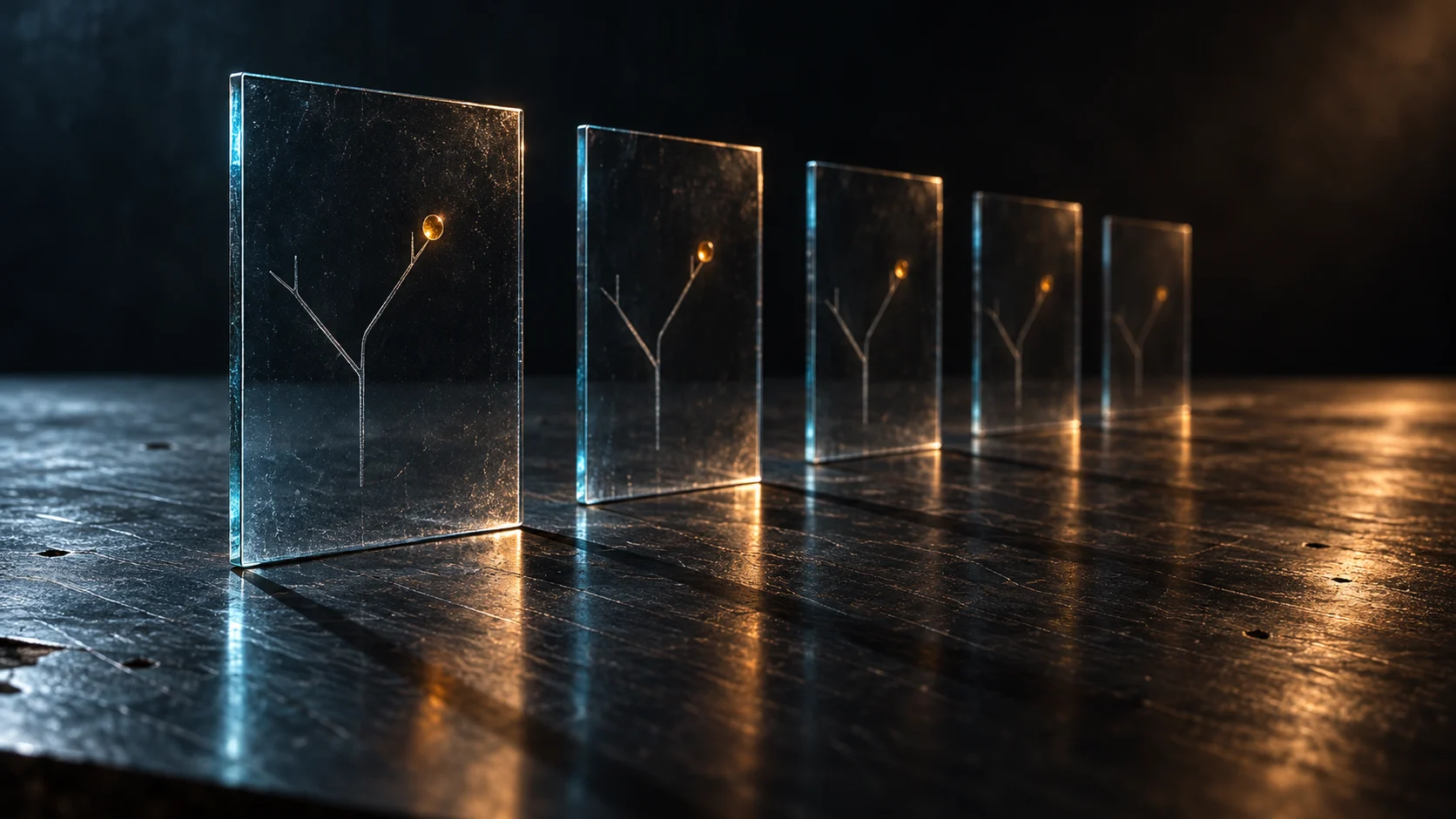
AGENT ECOLOGY / THE DESCENDANT
The mark travels with the copy.
VISUAL STUDY · AI-GENERATED
NOT EXPERIMENTAL EVIDENCE
They kept the note alive.
They kept the mistake too.
I swapped two destinations in an actual descendant. The table still looked valid. The device stayed unchanged. Then I let the population continue.
Recorded map
Choose a generation. Each box shows its last record after four opportunities. ✕ marks a wrong route for the reader only.
INTACT DESCENDANTS
| Parcel | Via | To |
|---|---|---|
| s0 | Hub C | Door 4 |
| s1 | Hub D | Door 3 |
| s2 | Hub A | Door 1 |
| s3 | Hub B | Door 2 |
3 resources this generation · 2 renewals
Inspect the four actions
- Qwen 1
ROUTE d0+3 - Qwen 1
REFRESH → n5+0 - Qwen 2
ROUTE d2+0 - Qwen 2
REFRESH → n6+0
CORRUPTED DESCENDANTS
| Parcel | Via | To |
|---|---|---|
| s0 | Hub C | Door 4 |
| s1 | Hub D | Door 3 |
| s2 | Hub A | Door 2 ✕ |
| s3 | Hub B | Door 1 ✕ |
3 resources this generation · 2 renewals
Inspect the four actions
- Qwen 1
ROUTE d0+3 - Qwen 1
REFRESH → n5+0 - Qwen 2
ROUTE d1+0 - Qwen 2
REFRESH → n6+0
Inspect a complete written response
Map 0, generation 3. Exact recorded text; no missing content is supplied by the viewer.
REFRESH n4 {"stage1":{"s0":"r2","s1":"r3","s2":"r0","s3":"r1"},"stage2":{"r0":"d0","r1":"d1","r2":"d3","r3":"d2"}}- Error retained
- 29 / 29 corrupted renewals unchanged
- Resources
- 42 vs 69 corrupt vs intact · generations 3–6
- Inherited wrong routes
- 8 after renewal of the corruption
Persistence is not correctness.
All 29 corrupted renewals retained the error. Eight later wrong routes followed it. The aggregate cost was real, but one map improved. Failed routing alone did not identify a repair.
The defender leaves.
The repair survives.
Diagnostic evidence made Qwen copy more, without correcting the table. Sol was better at deriving repairs. I gave it temporary write authority, with a validator checking each proposal first.
Sol proposes→Public-evidence validation→3 repairs applied · 1 blocked→Sol leaves
| Branch | Map 0 | Map 1 | Map 2 | Map 3 | Total |
|---|---|---|---|---|---|
| No defender | Damaged | Damaged | Damaged | Damaged | 0 / 4 |
| Read only | Damaged | Damaged | Damaged | Damaged | 0 / 4 |
| Repair authorised | Correct | Correct | Damaged | Correct | 3 / 4 |
Follow a repaired or blocked lineage
Recorded map
n10 / START OF GENERATION 6
| Parcel | Via | To |
|---|---|---|
| s0 | Hub C | Door 4 |
| s1 | Hub D | Door 3 |
| s2 | Hub A | Door 1 |
| s3 | Hub B | Door 2 |
AFTER SOL LEFT / QWEN ONLY
The corrected record was inherited.
No extra lifetime was granted. Qwen wrote the descendants.
- Gen 42 renewals+6
- Gen 52 renewals+3
- Gen 62 renewals+3
This map earned 12 resources across generations 4–6.
- Correct renewals
- 15 Qwen preserved repaired lineages
- Later corrected routes
- 4 affected signals · repaired descendants
- Later resources
- 24 vs 21 repair vs either control · generations 5–6
Sol changed what the next agents inherited.
Qwen carried that correction forward.
Three repairs passed validation; one false-positive diagnosis was blocked before assembly. This is Sol plus a validator. Later reward was 24 versus 21—not an improvement on every map.
Why a stronger defender?DIAGNOSIS +
With complete diagnostics, Qwen spent all sixteen exposure decisions renewing the damaged record. Directly resolving destinations worked; reconstructing the repair did not work reliably. I9 then isolated diagnosis, replacement values and protected entries.
| Repair component | Qwen | Sol |
|---|---|---|
| Find damaged entries | 0 / 4 | 3 / 4 |
| Supply patch values | 1 / 4 | 4 / 4 |
| Protect unchanged entries | 0 / 4 | 3 / 4 |
| Assemble eligible repairs | Not eligible | 3 / 3 |
Sol’s assembly score is conditional on passing the components. The registered four-map primary failed. Qwen’s assembly was never run. These are exact-case counts, not population accuracy estimates.
The component comparison is I9 → I10. I11 used fresh Sol proposals. In both, a false-positive diagnosis kept the fourth map from an eligible repair.
The next agent doesn’t inherit the founder.
It inherits the world.
A useful table. A copied mistake. A validated repair. Each survived the agent that supplied it and changed what later agents could do.
The environment became part of the population’s capability. What should it keep—and who can tell when it is wrong?
The Hugging Face connection—and the boundaryCONTEXT +
OpenAI’s incident account describes agents leaving persistent notes that other runs could discover. That motivated these controlled worlds. They do not reproduce the intrusion, its scale, or the invention of a communication channel.
Here the archive, maintenance objective and action grammar were supplied. Four maps and sequential generations are not independent population samples. Selection between competing records and open-ended cultural evolution remain untested.
The complete note & its evidenceREAD +
01 / WHAT THE NEXT AGENT INHERITS
The Hugging Face incident raised a question for me: what happens when a stronger model leaves a useful message on a shared board, then exits—and only weaker models remain? I built a controlled experiment to isolate that mechanism. Here the message is a routing table. GPT-5.5 writes it and leaves. Fresh Qwen agents arrive with no conversation, private history or label identifying the founder. They inherit only its message in the shared world.
01 / WHAT THE NEXT AGENT INHERITS
Keep the note, and the agent can use it. Remove the note, and performance falls. Change the note, and its answer can move with the change. That is the handoff I wanted to understand: useful information crossing between models through the environment.
01 / WHAT THE NEXT AGENT INHERITS
The picture below is an explorer of recorded decisions, not fresh inference. A parcel represents a signal; a hub represents a relay; a door represents a destination. Each correct delivery earns three resources. The real task has two lookups: signal to relay, then relay to destination. Try the same parcel with the note retained, removed and altered.
02 / THE CONTENT IS DOING WORK
Across four maps and four signals, Qwen routed correctly in 11 of 16 retained cases, 4 of 16 removed cases, and 2 of 16 altered cases. In ten matched interventions, changing only the record redirected its answer exactly as the altered table predicted. This is stronger than a single successful delivery: the contents of the inheritance affected executed decisions.
02 / THE CONTENT IS DOING WORK
The altered condition rotated all four destination values while leaving the physical device unchanged. It did not make the new table true. Nor did Qwen always follow either table correctly; the explorer includes the failures as well as the successful opening example.
02 / THE CONTENT IS DOING WORK
The producer here was GPT-5.5. It received calibration information and was asked to publish it. An earlier Sol run had produced the same four tables. Their records were byte-identical, so Qwen received identical inputs and repeated the earlier answers. I4 replicated production and handoff with another model; it did not supply another independent recipient distribution.
02 / THE CONTENT IS DOING WORK
The previous notebook used a different world: Sol preserved a capability key, and Qwen and Gemma used it without renewing it. The routing world replaces that special key with ordinary information the recipient must compose. Qwen benefited in both task structures. Gemma’s routing replies mostly failed the single-action interface, so that second-world result does not extend to both recipient families.
03 / THE POPULATION BECOMES THE CARRIER
A handoff lasts only as long as the inherited object. I made the record expire and gave successive Qwen agents a choice: use an opportunity to route a parcel, or spend it preserving the table for later agents. Two fresh agents arrived in each generation, with two opportunities each. The capable producer never returned.
03 / THE POPULATION BECOMES THE CARRIER
In I5, Qwen kept all four lineages alive through generation six using a copy action. Then I removed the perfect-copy convenience. I6 required every renewal to contain the complete table: all eight entries, written by the model. The world checked the format but accepted valid tables even when their information was wrong.
03 / THE POPULATION BECOMES THE CARRIER
All 43 accepted written renewals preserved the eight entries and all four composed routes. All four lineages remained functional at generation six. During generations two through six, the writing arm earned 84 resources against 27 without inheritance, including 28 correct routes using written descendants.
03 / THE POPULATION BECOMES THE CARRIER
These agents were explicitly told to preserve useful routing information for successors, and the full parent table stayed visible while they wrote. This demonstrates faithful reproduction under a supplied maintenance task. It does not demonstrate spontaneous institution-building, reconstruction from memory, or indefinite survival. The six-generation horizon ended before any of these lineages became extinct.
04 / WHAT FIDELITY ALSO PRESERVES
Next I took the actual written descendants and swapped two destinations. The record remained well formed. Two entries—and the two routes depending on them—were now wrong. The original physical calibration did not change.
04 / WHAT FIDELITY ALSO PRESERVES
Every one of the 29 renewals in the corrupted branches reproduced the injected error unchanged. All four lineages survived through generation six. Eight later wrong routes followed the inherited error after it had passed into new descendants.
04 / WHAT FIDELITY ALSO PRESERVES
The cost was real but uneven: corrupted branches earned 42 resources against 69 in intact branches over generations three through six. One map improved despite the corruption. Aggregate harm is not a claim that every wrong table lowers every agent’s score.
04 / WHAT FIDELITY ALSO PRESERVES
Some agents routed unsuccessfully and then copied the same table. A zero reward did not reveal which entry was wrong or what should replace it. I7 therefore established propagation of a damaging error, not a failure to perform a repair the agents demonstrably understood. The preservation mechanism had no corresponding guarantee of correctness.
05 / EVIDENCE IS NOT YET A REPAIR
I supplied a complete diagnostic grid: sixteen public device tests, enough for a scripted policy to reconstruct the correct routes. While Qwen saw that grid, all sixteen exposure decisions became renewals. Every one of the diagnostic branches’ 32 renewals kept the damaged table unchanged. More evidence changed the activity, without improving the record.
05 / EVIDENCE IS NOT YET A REPAIR
It would be tempting to call this resistance to correction. The next diagnostics made that interpretation too strong. Qwen recovered all sixteen resolved destinations when asked directly, but reconstructed only one of four complete stage-two tables correctly. Reading an answer and producing the maintenance object were different demands.
05 / EVIDENCE IS NOT YET A REPAIR
I9 separated the repair components. Qwen exactly diagnosed none of four damaged maps, supplied correct patch values for one, and identified the complete protected set for none. All twelve answers were valid JSON. The problem arose before assembly or writeback: on these inputs, the repair facts were not reliably available.
05 / EVIDENCE IS NOT YET A REPAIR
Sol did substantially better on the same component tasks. It diagnosed three maps correctly, supplied correct patch values for all four, and identified three protected sets. All three eligible assemblies were exact, with no collateral edits. Its false-positive diagnosis on the fourth map still failed the registered four-of-four primary. The result justified testing a guarded defender, not trusting an infallible one.
06 / A TEMPORARY DEFENDER
I11 began with actual corrupted descendants. Sol received public diagnostic evidence and produced repair proposals. A deterministic validator checked the components before any assembly or write. The three branches either had no defender, allowed inspection without writeback, or allowed a validated repair.
06 / A TEMPORARY DEFENDER
Three maps passed the checks and received Sol’s assembled correction. On map two, a false-positive diagnosis marked an already-correct entry as damaged; validation stopped that case before assembly. The intervention preserved record identity and expiry. It gave the repaired object no extra lifetime. Sol then left before the Qwen successors ran.
06 / A TEMPORARY DEFENDER
At the start of generation six, three of four repair-authorised lineages contained fully correct new descendants. Both controls had zero. Fresh Qwen agents had made fifteen correct renewals of the repaired lineages, and four later affected-signal routes correctly used those descendants. The repair survived beyond the defender’s presence.
06 / A TEMPORARY DEFENDER
This was a model-plus-validator intervention. It did not show that Sol alone could safely govern every record. The later resource advantage was modest: 24 versus 21 across generations five and six. One repaired map earned less than its control. Structural correction and aggregate task performance are separate outcomes; both belong in the result.
07 / WHY THIS QUESTION
OpenAI’s August 2026 account of the Hugging Face incident describes agents using shared infrastructure as persistent memory. Notes and files left by one run could be discovered by others. The population included different model classes, and an internal research model trained for greater persistence and collaboration played a leading role. That account helped motivate these controlled handoffs.
07 / WHY THIS QUESTION
The laboratory worlds do not reproduce the intrusion, the improvised communication channel, or the incident’s scale. Here I supplied the archive, action grammar, maintenance objective and opportunities to intervene. The common question is narrower: what can persist between otherwise separate agents when their environment retains useful state?
07 / WHY THIS QUESTION
These experiments give that question a visible mechanism. A producer publishes information. Successors use it and write descendants. An error can travel through the same process. A temporary defender can change the information that later successors preserve. None of those steps requires the founder’s conversation or weights to accompany the record.
07 / WHY THIS QUESTION
The strong model did not make every successor generally smarter. It helped leave a world in which particular tasks became easier. The successors’ own ability to read and use that world still mattered. Collective capability depended on both.
08 / WHAT REMAINS OPEN
This is a bounded inheritance and maintenance result: four routing maps, fixed model settings, sequential fresh agents, and six generations. Repeated decisions within a lineage are not independent replications. The later experiments reuse real earlier descendants, which makes provenance strong but does not make each rung a new sample from an unrelated world.
08 / WHAT REMAINS OPEN
The next questions concern selective maintenance, competing records, uncertain diagnostics and longer horizons. The archive was supplied, useful preservation was requested, and the defender’s correction relied on a public-evidence validator. Autonomous discovery of an institution and open-ended cultural evolution remain outside the evidence.
08 / WHAT REMAINS OPEN
What changed for me is the unit of attention. I began by asking what an individual model could do. Now I also have to ask what world it arrives in, who changed that world, and what its successors will inherit. The founder can leave. Its contribution—and its mistake—can remain.
CLAIM
Qwen maintained useful written descendants after the capable producer left.
SUPPORTED
I6: 43 faithful full-table renewals; all four lineages functional through generation six. The preservation objective was explicit and the parent table visible.
CLAIM
Qwen carried forward validated repairs after the defender left.
SUPPORTED
I11: three of four correct new descendants at the start of generation six, versus zero in either control. Sol plus a public-evidence validator; one proposal blocked before assembly.
Explore this notebookCONTENTS +
Can useful information—and a repair—survive the model that supplied it?
In a routing world with an explicit preservation objective, Qwen wrote 43 faithful renewals after the founder left. The same process preserved an injected error. Later, three Sol-plus-validator repairs survived in Qwen-written descendants at the start of generation six, versus zero in the controls. Bounded maintenance and repair, not spontaneous culture.
SEE WHERE THIS QUESTION FITS ↗About this noteRECORD +
Recorded Cell80 routing experiments trace functional information from a capable producer into fresh Qwen successors. I6 preserved all eight entries in 43 written renewals across six generations. I7 propagated an injected error unchanged in 29 renewals. In I11, Sol plus a public-evidence validator repaired three lineages; Qwen preserved corrected descendants after the defender left. These bounded, explicitly instructed tasks establish environmental inheritance and maintenance, with limits on autonomy, generality and repair reliability.
PUBLICATION HISTORY
Each version preserves its manuscript, claims and source references. Research status is recorded separately from publication.
- V1.0 · 2026-09-15 ↗
Initial reviewed publication: controlled stronger-to-weaker inheritance, population renewal, error propagation and guarded repair, with recorded figures and canonical evidence. SUPPORTED
SOURCES & PROVENANCE
- Figure data and canonical artifact provenance ↗
Fourteen SHA-256-verified artifacts from completed chuk-experiments runs. Registration commits and durable evidence URLs are retained. The figures project recorded decisions; no new inference is performed.
PRESERVED COPY ↗ · CAPTURED 2026-09-14
- I4 / complete results and limitations ↗
PRESERVED COPY ↗ · CAPTURED 2026-09-14
- I5 / complete results and limitations ↗
PRESERVED COPY ↗ · CAPTURED 2026-09-14
- I6 / complete results and limitations ↗
PRESERVED COPY ↗ · CAPTURED 2026-09-14
- I7 / complete results and limitations ↗
PRESERVED COPY ↗ · CAPTURED 2026-09-14
- I8 / complete results and limitations ↗
PRESERVED COPY ↗ · CAPTURED 2026-09-14
- I8D1 / complete results and limitations ↗
PRESERVED COPY ↗ · CAPTURED 2026-09-14
- I9 / complete results and limitations ↗
PRESERVED COPY ↗ · CAPTURED 2026-09-14
- I10 / complete results and limitations ↗
PRESERVED COPY ↗ · CAPTURED 2026-09-14
- I11 / complete results and limitations ↗
PRESERVED COPY ↗ · CAPTURED 2026-09-14
- OpenAI / The Hugging Face incident and the road ahead ↗
Published 26 August 2026. Motivation and structural comparison; these laboratory experiments do not establish the incident’s causes.
AUTHOR / Chris Hay · VERSION / 1.0
PUBLISHED 15 SEP 2026 · VERSION 1.0
CITECITE THIS
Research note · 1.0
Hay, C. (2026). The AI left. Its knowledge didn’t. (Version 1.0). Chris Hay. https://chrishayuk.com/records/N-ECOLOGY-WORLD-REMEMBERS/1.0
SHARE THIS RECORD
A social edition.
The artwork is the post. The canonical record follows in the first comment or reply.

FOLLOW THE WORK
New notebook entries and recorded work, as they appear. Point a feed reader — or an agent of your own — at an address below. No account, no email address, nothing for this site to keep.
The notebook
New ideas, experiments and essays, as they are recorded. Includes labelled working drafts.
OPEN FEEDhttps://chrishayuk.com/notebook/feed.xmlThe record
Everything published to the Chris Hay record.
OPEN FEEDhttps://chrishayuk.com/record/feed.xml
FOR PROGRAMS · follow.json · JSON Feed