The next word. The rest of the conversation.
Working manuscript · v0.1
What can be rebuilt is different from what can be forgotten.
01 / KEEPING THE STATE
A cache keeps work we would otherwise repeat. If its contents can be reconstructed, we can choose another way to retain the conversation. But we still owe an account of what remains: which positions, which layer boundaries, which tokens and which metadata.
ONE OBJECT · TWO INTERPRETATIONS
Two different interventions
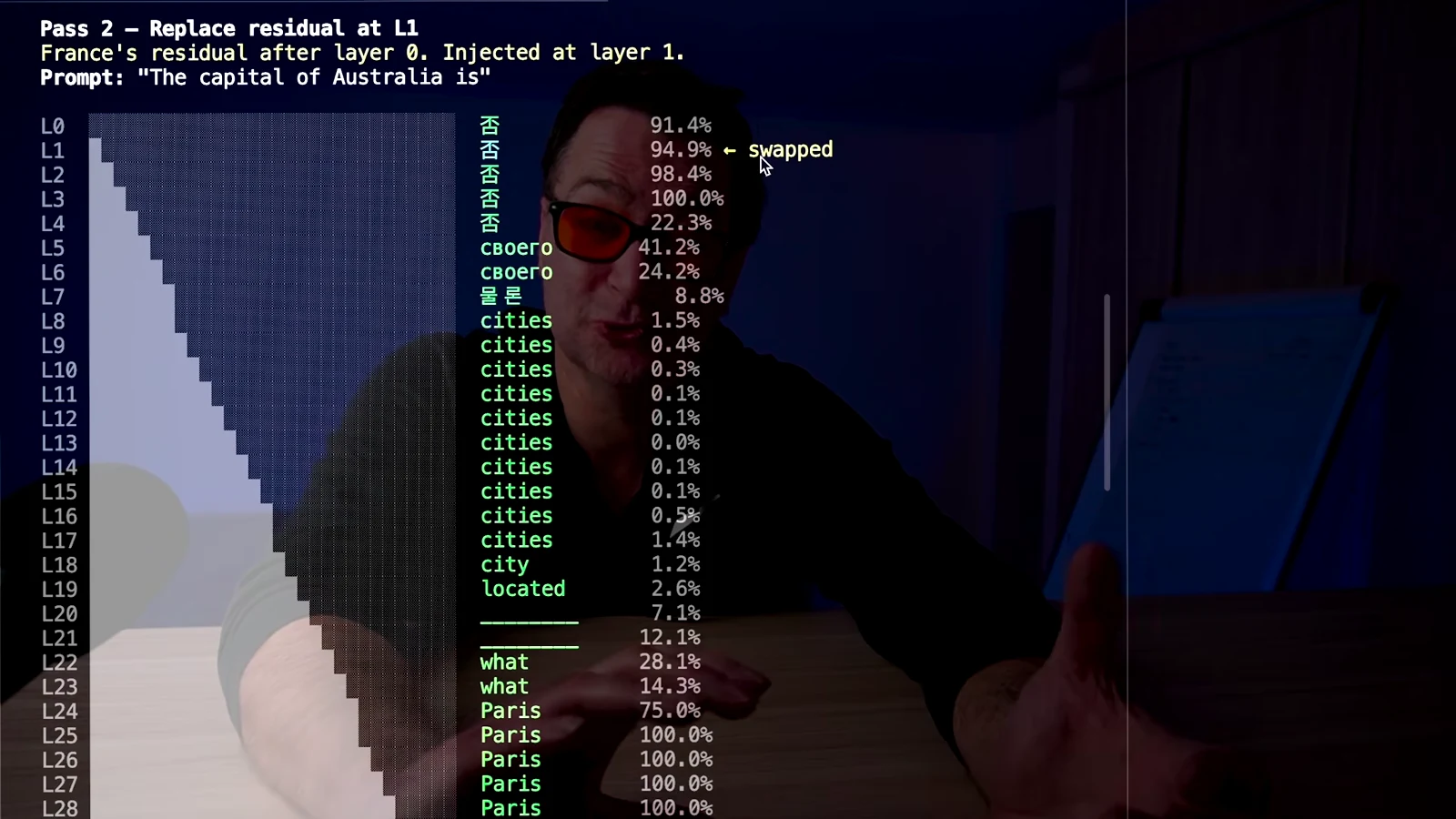
Replace the current token’s residual
Earlier positions remain available to attention
A changed next word need not persist
Replace all positions at a defined boundary
Transfer the tested donor computation
A different claim from persistent decode state
EVIDENCE
Full-sequence transplant / three conditions
The recorded all-position transplant produces the donor’s next-token distribution with KL = 0 in three tested conditions at L14/L26 on Gemma 3 4B. An earlier register entry lacked an all-position patch tool; the later transplant records the completed test. The result concerns these full-sequence forward-pass interventions.
02 / AFTER THE FIRST WORD
MAP-5 asks whether a donor state can control a later branch. In its planets test, repeated patches work at L24 and L28 but fail at L20. That brackets the tested transition between L20 and L24. It does not establish that a universal thought appears at layer 24.
PERSISTENCE WAS NOT MEASURED HERE
- MAP-5’s one-shot continuation used stateless, full recomputation between calls.
- That harness does not retain the patched hidden state across decode steps.
- Bounded hot memory is not constant total memory: the documented engine also retains a growing cold tier.
Name the state before calling it sufficient.
What changes when the patched state really persists?
The recorded follow-up compares residual-only, token-only and residual-plus-K/V interventions in incremental decoding. The K/V intervention work was explicitly deferred. This remains a research question, not a claim that the test has run.
Thematic notebook / Working draft
Closing thought
The question is which state must survive at which boundary. Full-sequence transplantation, a single token’s residual and persistent decode state make different claims about continuation.