What can a model’s changing state tell us?
From the residual map to interventions, addressable memory and the software built around it.
From the film / 02:35–02:40
Follow the residual state.
A projected trajectory moves among Tokyo, Paris, Berlin and Cairo. The note examines what the picture can—and cannot—establish.
Watch the source film ↗Read the note ↗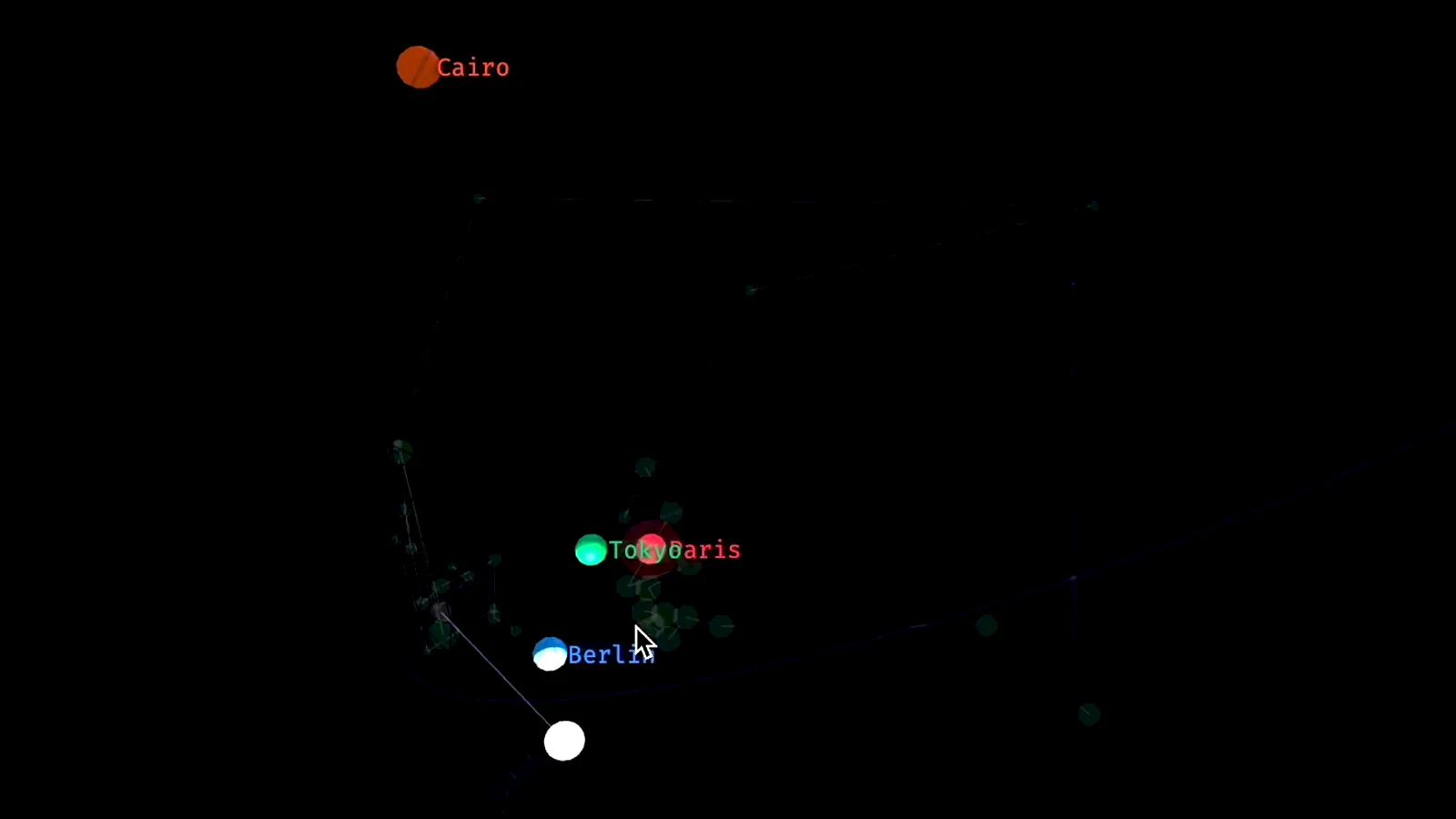
Reading order
- 01
370,000 tokens loaded in Context in 2.8MB, on a MacBook.
Begin with the capital of Japan. The film follows the changing residual state, then asks what happens when a France state enters an Australia computation.
ORIGINAL FILM - 02
What is the map actually a map of?
Which token position is moving? What are the axes? The notebook reads the demonstration alongside its projection code and distinguishes a useful picture from an answer probability.
WORKING DRAFT · OPEN - 03
What has to survive?
Replacing one position and replacing the full sequence are different interventions. Follow the transplant evidence into the question of what must persist after the next word.
WORKING DRAFT · OPEN - 04
Reading by address.
A state becomes useful when an operation can read it. Follow key matches, activations and value contributions, then compare the constructed memory with the native-model experiments.
WORKING DRAFT · OPEN - 05
Try the mechanism.
Choose capital of Atlantis. Inspect the competing activations, remove a neuron and watch the answer scores change. Every operation in this little memory is visible.
CONSTRUCTED EXAMPLE - 06
Which source wins?
A stored memory eventually holds two things that disagree. Follow the recorded arc from a record that replaces a retired source, to one that is completely inert against a source still being read.
WORKING DRAFT · OPEN - 07
Which source wins?
Eight attention layers can see the whole context. Switch one off and the newer record takes the answer. The study replays what was measured, and stays silent about what was not.
RECORDED RESULTS - 08
The address is built through depth.
Return to native facts. A final-position transplant and an independent reader locate the entity transition between L24 and L28. Explore the early relation frame and changing coordinates, with the answer-token endpoint marked explicitly.
WORKING DRAFT · SUPPORTED - 09
LARQL
LARQL explores how learned systems can be queried. Return from the small memory to the larger engineering question: which operations can a model reliably expose?
WORKING DRAFT · ONGOING - 10
VINDEX3
If a model has parts we can address and relationships we can inspect, how should we represent them? VINDEX3 gives that question its own system and specification.
WORKING DRAFT · ONGOING
About this programme
What can a model’s changing state tell us about the way it reads? Follow the map film through the visual notebooks, studies you can work yourself, and the questions behind LARQL and VINDEX3.
A curated reading order, rather than a chronology of discovery. Films keep their original dates. Notes and dossiers remain working drafts. Interactive studies are labelled as either constructed examples or replays of recorded results.
What would make the address reliable?
Changed phrasing, competing entities and use beyond the first answer remain part of the question.